Tessellations in Time

If your Lordship should consider that these observations may disgust or scandalize the learned, I earnestly beg your Lordship to regard them as private and to publish or destroy them as your Lordship sees fit.” – Anton van Leeuwenhoek

van Leeuwenhoek was the first person to study microbial organisms from his local pond in great detail in the 17th century. He developed his own macro camera aka the compound microscope! He was the first person to witness the blood flow in capillaries. All chaste subjects! But his colleagues egged him on to venture beyond the prevailing ethics of the time. He finally came around to the idea and examined his own ejaculation.

Life is rife with speculations, but especially so during his time. Some theories suggested that tiny pre-formed humans were nestled inside the sperm cells. Even Leeuwenhoek himself was skeptical about the ‘blasphemous’ experiments. Hence, the above disclaimer while sending the results to the Royal Society. Remember Galileo. Remember Giordano Bruno. 

But Leeuwenhoek was fortunate to be in good company. The same cannot be said of sperm cells. They have to fulfill their destiny in a foreign environment. While they do not have a pre-formed life, they do possess the precursors that can bring life in conjunction with their counterparts. Millions perish, but they need to be successful only once.

Twelve thousand years ago, I might have hoped to go for a nice swim in Death Valley and make a hearty meal out of some crustaceans, not too unlike the organisms studied by Leeuwenhoek. If I were observant enough now, I could have come across the chemical remnants of the species that once called this place a home. An abundance of moisture, and a low-lying basin with no outlet made for a flourishing environment in a sub-tropical climate. But the tide changes with time. A host of geological factors that led to increasingly arid climate choked the pluvial lakes on their own minerals. Now, on a clear and warm evening,  I walk among the neat, geometrically energy-efficient alkali crust left behind from ages of desiccation. 

And on rare years, as thunderstorms bring rain to the valley, I see the tessellations disappear in a salty slush. I see before me a memory of what once was. 

The next morning, I hike up and away from the tessellated hexagons. With the elevation as my guide, the intricate patterns in the salt flat, the alluvial fans from the dried-up lake bed, the residuum of a plethora of species that was, the dirt and dust and mud in the this Land of Little Rain– all coalesced into a green oval spermatozoon.

A camouflage of biological life, waiting with the elements. For the tide to turn again. For the Tüpippüh to flourish once more.

(adapted from original writing in 2021)

Utah Over The Years (Part I)

If it was not for the Adirondack Mountains, I would have strived to make a living in Utah. Over the years, I have been fortunate to visit different parts of Utah. I am terribly lazy and scatter-brained when it comes to processing my photos; and now with multiple trips over the years, they are starting to pile up. This is an attempt to revisit the files in hard drives, recall some of my favourite memories, and process (in some cases re-process) the images. This is not an attempt to create a portfolio of the best images or categorize in any other way. 

I believe that in order to truly understand a place, one must live there. And if creation is an expressive testament to that understanding, then my images fall vastly short. Having acknowledged that, I feel that I have tried my best to understand Utah as much as an outsider can- by coming back to the same place, in different seasons, and in the same seasons in different years, reading and learning about the place, and contemplating the works of different artists from the region. All of the above have helped me make some images that I would like to share in a chronological order for the sake of simplicity.

The first one titled Fremont Gold is from 2018. Due to difficult personal scenarios, many parts of this trip were miserable but this late December afternoon, shivering by the river, was a welcome respite from the misery.

This one titled Step Into the Light is from 2020. This was my fifth trip to Utah but the first time during the Fall season. It was my first solo visit to Utah as well which meant there was no fixed itinerary or time table, thus making it the best kind.

This image, titled Dance With Me, is my personal favourite from this trip. The easy access from the roadside pullout brought me such joy every time I drove past this grouping of trees in the subsequent years. Alas, this year, I found that some of the trees have fallen.

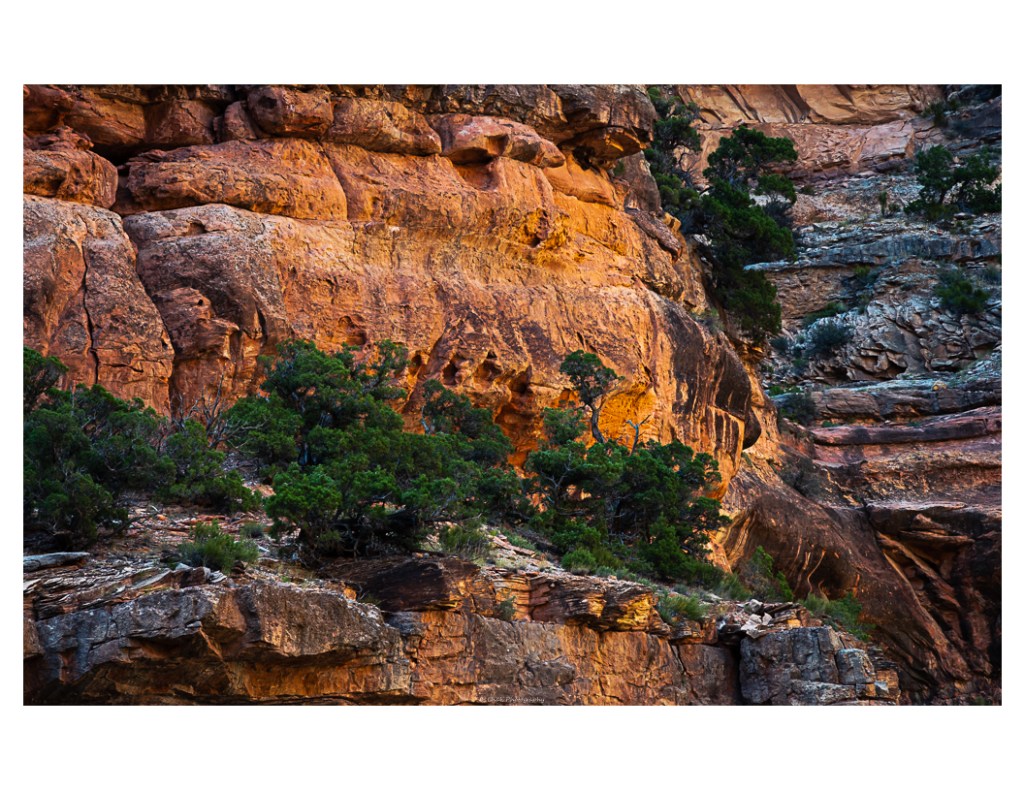
From the same trip in 2020 came this image titled Canyon Possessed. I cannot say how far images go but touching canyon walls in person is a strong, strange feeling, and something I look forward to on every visit.

It took me another two years to witness the glory of cottonwoods in Spring. Here is one from my first Spring visit in 2022 titled 9 AM Light.

Though I have driven through Cathedral Valley thrice before, I camped up there for the first time in 2022 for three days. Here is one image titled Idle Afternoons.

The next few images are from this summer of 2023. Part of the trip was solo and part of it was in the company of good friends and passionate photographers- Eric Erlenbusch (@lausivee) and Prajit Ravindran (@irockutah). All the following images were made while exploring some new (to us) locations with Eric and Prajit. Though ‘three is a crowd’, it did not feel like that for once. Both of them are eccentric and serious in their own ways and helped me learn by observing their approach to making images.

Afternoon Amble– one from our very slow, never tedious, walk in a canyon.

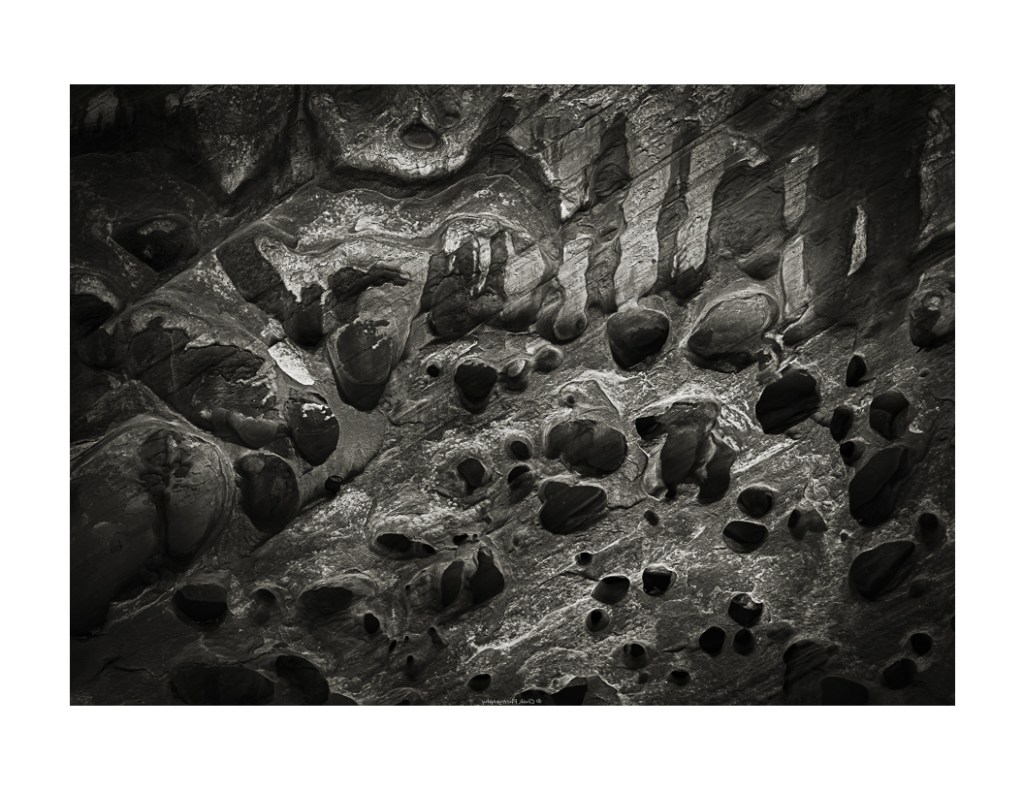
Varnish Drip– the varnish on this canyon almost resembles petroglyphs.

How Is This Possible?– this is what I was thinking (and possibly Eric too) as we came across this scene.

The Stars Below

The River Knows Its Way

The Light Fades

When the Clouds Move

To Be a Flower

Does It Ever Fade?

Forward to the Past

DSC07585-4

You took the first portrait of me. I was just over a little year old, probably sleeping when you clicked the photograph. My family did not know, quite possibly only a handful of people in the world knew about it at the time. It was a little secret that I discovered close to three decades later. Better late than never.

I was not alone in the portrait. The person who introduced me to books, the teacher who showed me the path to a good life, the friends who went along in stupid adventures, the love, and the heartbreaks- all were in that portrait. And so was a Dusky Seaside Sparrow, probably returning to its nest in the glory of a Florida sunset. The gentle giant Sudan was drowsing in captivity in a foreign land. The Saint Helena Olive was in full bloom with its pink flowers. A school of Baiji Dolphins were frolicking in the Yangtze River. I rode the bicycle for most of my daily activities. Disposable cutlery was unheard of in my family. Life was unhurried while you approached the edge of the solar system.

As you continue into the infinite darkness, Sudan has since been freed. But alas, he has breathed his last. And with him has dimmed the hopes of an entire species. The olives eventually met the same fate as an exiled emperor. The dolphins of the Yangtze have not whistled in years. Three decades and seven thousand miles later, I witnessed the first light on a surreal place. A glimpse into what the Earth must have been in its prime. An automobile is now a necessary part of my life. Plastic straws and styrofoam containers are not too uncommon. I have changed. We have changed. The memory that you carry of us- is but a memory. The blue dot from your younger days has become paler over time.

Four decades and fourteen billion miles hence, you do not need to take another portrait of me. But the sparrow can find its nest again. We might not be able to reverse the clock. But we can keep it ticking. And your swan song can be our overture. We are significant because we are insignificant.


Epilogue

When the steaming cauldron, that once held the primordial soup,

From where the sugars went right,

And the amino acids to the left.

Life found a middle ground, evolving over eons,

Till the ‘intelligent species’ took over.

And the cauldron started to spill.

Too many cooks indeed spoil the broth.

Because we need the sun at night,

And the blinds by daylight.

Have you ever paused at the phrase ‘fossil fuels’?

How we built our lives, entire civilizations from Her graveyards?

Without mourning, without reverence.

But Her heart weeps

With the melting glaciers.

When shall we learn?

That when there is nothing left to burn,

All will burn.

And when the dust settles,

She will be ready with more love, and fuels.

But who will be there to receive it?

(Or it might be that the fact we are not trying to stop the madness is actually Nature’s

survival tactics? Maybe the only way to reset the environment is by extinction of the

human race that depends on us not caring about it?)


A humble tribute to Voyager I and Carl Sagan on Earth Day, with the dream of a better world.

Do I See?

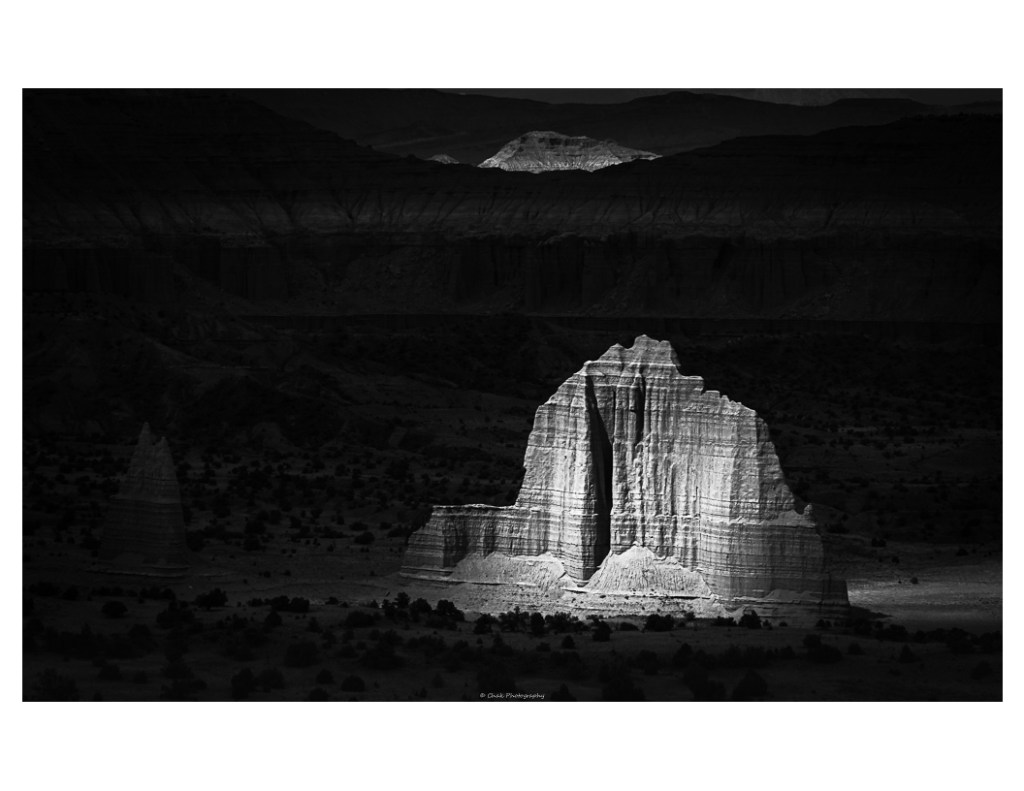
Chakraborty_S_Temple of the Sun

Do I see?

Needless to say, there is a basic premise, a singular point (if you will) from which landscape photography originates, that is an appreciation for the landscape. Whether you have the eye for natural beauty, adulation, if not reverence for the grand design all around us! Do the crimson hues of twilight excite you; do you take a drive to the hills, if only to take a break from the urban drudgery? If so, then all hope is not lost.

DSC00258-Pano

Can I show what I see?

From Wordsworth’s poetry to Zachariah Mutai’s duty, humans are capable of love for Mother Nature in myriad ways. But in this context, we shall limit the discussion to photography. To merely capture what you see, to ‘represent’ a landscape as termed by many artists, all that is needed is technical proficiency. If you know the basics of your camera, you are guaranteed an image. In some instances, especially when visiting iconic locations like Mesa Arch at sunrise, you probably do not even need to master composition. The scientists and the engineers behind the design of the camera, pushing auto-focus and ISO to extremes, are probably the ones being creative and not you, the person using the camera.


Chakraborty_S_Transition

Do I feel?

Ah, feelings! A slippery slope to ascend. Or descend. Shrieking with excitement at the reflections of pretty twilight colours on a clear lake- is that enough of a feeling? Or when your feelings are not limited to one particular sense, when you can smell the mist while shivering in the crisp dawn, standing knee deep in water while your pupils dilate with the rising sun- would you say that then you have felt something? Would you then claim that you feel what you see? Or is it when you are staring at barren rocks stretching for miles into the horizon in the flat light of the hot desert sun and yet you feel nothing but joy, photography be damned, because you know this place like a friend?

2_Rock Alchemy

Can I express my feelings?

Now that you know a place, more than an acquaintance or a customary ‘nice to meet you’, you can connect to the place at an emotional and spiritual level. And the connection is not limited to a reactionary one- a gorgeous alpine sunrise that you witnessed after a personal loss might produce a melancholic hope, a forest charred by wildfire might fill you with grit to go all the way, standing on the edge of a canyon and staring into the abyss might make think that you matter too, at this moment of time, if only to yourself. And if you can express this connection through pixels and photons, you will produce something that is more than a photograph. You will make an image of yourself, shaped by the synthesis of the individual and the landscape.

Do not ignore the basecamp

I have been fortunate enough to travel to some of the national parks and monuments in the United States and witness Nature at its best. White Sands National Monument was one such place (more on that probably in a later post) where my wife and I went in the summer of 2017. We stayed in a town called Las Cruces which is about an hour drive from White Sands.

When you have the target to visit one particular place and if it is a protected area with no lodging options (except for some limited form of camping), you are forced to stay elsewhere. While all your time is spent at the intended destination, the base-camp becomes merely a place to rest your tired bodies at the end of the day or take a quick shower to freshen up before next day’s exploration (which is again not where you are holed up!).

However, more often than not, I have regretted not spending much time at the place of lodging. In this particular trip, we stayed at a beautiful farmhouse in Las Cruces with a great view of the Organ mountains. We had extraordinary star sightings and the best sunrise views right at our doorstep. We did not plan on this but to witness it was a happy accident as the White Sands are open after sunrise and closes at dusk (unless you have a permit). The green fields with the mountains as backdrop also provide good photographic opportunities (that is stark opposite of the vast barrenness of the White Sands). Another advantage is you can escape the crowd of the White Sands which can be annoying (especially during sunset) if you are a quiet person and prefer solitude and calm for making images.

DSC09734

Sunrise over the Organ Mountains

DSC09786

Golden light at doorstep

While iconic locations are popular for obvious reasons and there is no harm in seeking them out, it can be highly rewarding to make time for exploring the places around it, the area where you are residing at and maybe, you will come back with better images and stories to share.