When despair for the world grew, Wendell Berry came to The Peace of Wild Things and “felt above him the day-blind stars waiting with their light”.1
He came to wild things because he was not with his light.
And the future found his words, waiting with their light, in times of despair.
Primo Levi saw The Black Stars, where “The sky is strewn with horrible dead suns, Dense sediments of mangled atoms.”, and where “Light itself falls back down, broken by its own weight…”.2
If all is stardust, why is one better than the other.
Why did Berry’s words not find its way to Levi?
“Though my soul may set in darkness, it will rise in perfect light; I have loved the stars too fondly to be fearful of the night.” said The Old Astronomer to His Pupil, as told by Sarah Williams.3
If you do not learn a star now, how do I believe you will stand up for a constellation.
“Heart from heart is all as far, Fafaia, as star from star.” wrote Rupert Brooke.4
If I have to explode to create, then so be it.
If you are in awe, how can you be in the heart of things.
“Right now is good, and that’s all that matters.” – Guy Tal
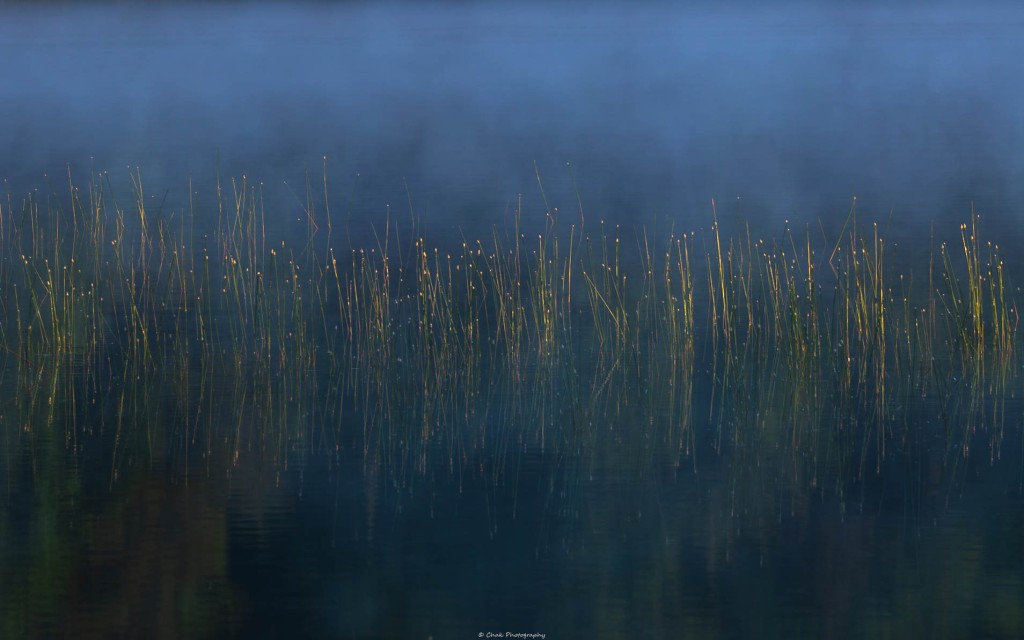
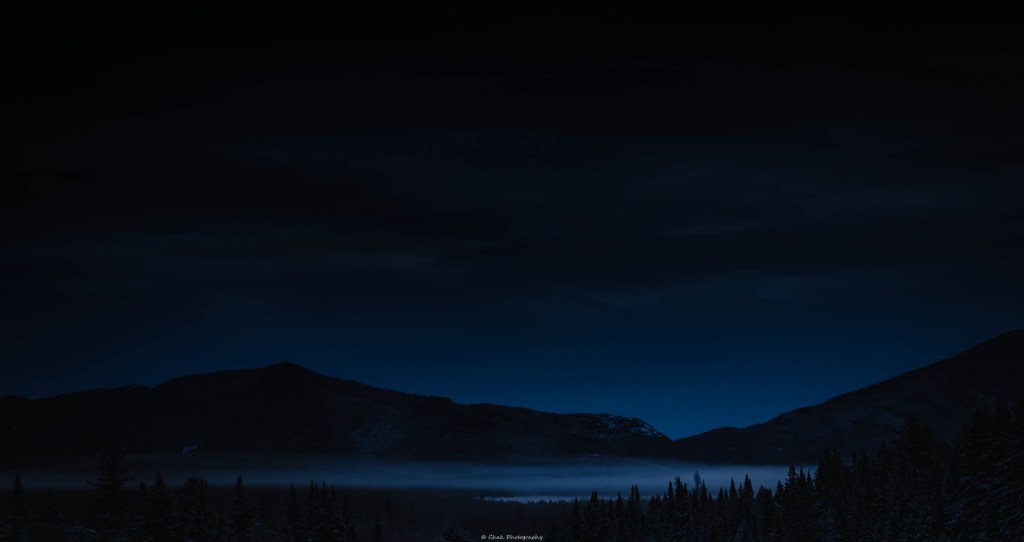
This is the place- where a rebel finds peace, an outlaw becomes a poet. The mist rises, and the dust settles. Here, storms and sorrow, laughter and mountains mingle into one another. This is a place where you can watch the grass grow. And the valley is greener on your side. If you know of such a place, hold it dear. Bring your ears to the ground, listen to it whisper. You will change in a blink, and so will the place, in a few more. But for this moment in time, under this one sun, this place and you will command the language of the heavens.
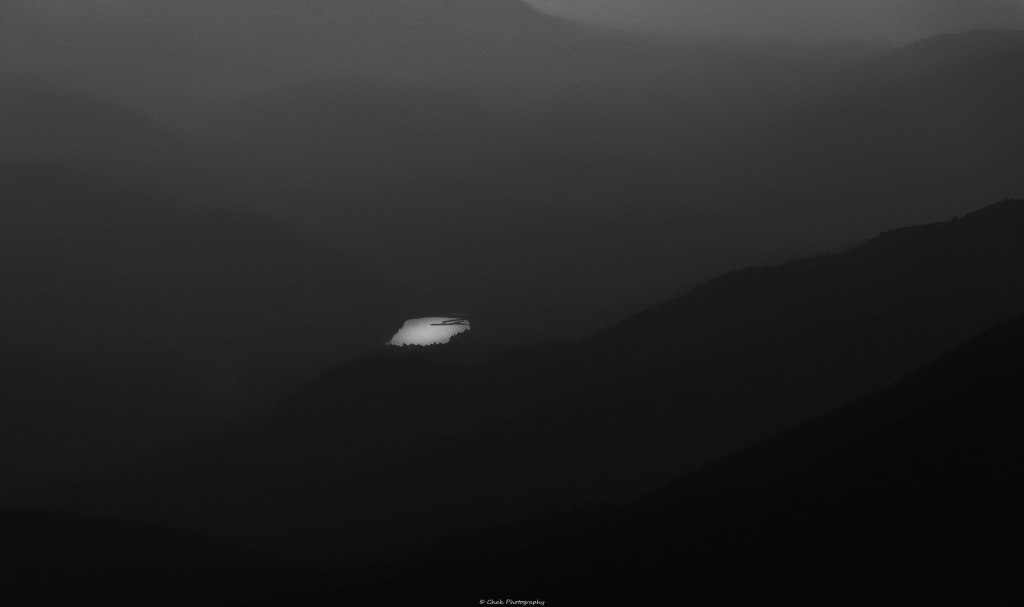
The mist here is more mystical than mysterious, unsure of destination, but welcoming of the journey. Not all can be known but much can be understood. Not everything can survive but all can live. And while there is no promise of eternity, this place preserves the sweetness in death.
This place tells a story beyond words and images, historical data and climate records, provable facts and documented knowledge. Your feet can only cover so much ground. But the mind can wander where footsteps cannot reach, imagination can complete the experience when memory has reached its limits. Ancient texts and scriptures promise you peace and prosperity, the ancients of this place grant you struggle and imagination.
Here, snow and ice, melting grays and freezing yellows, write a ballad and an elegy in the same breath. Every pause is a preparation, every cause is a rebellion, all in the act of carrying out the most magically mundane things.
Here, the sun is wantonly indiscriminate, disseminating light like the wisdom of an ancient sage. The bejeweled maple is no more privileged than the lifeless pine. And where there is no privilege, therein lies my pilgrimage.
If you do take the time, this place can offer it in things that are magnificently insignificant. In long and hushed goodbyes, as if farewell and funeral overlapping into one another. An exuberant hibernation, a jumbled mess of marcescence and photosynthesis.
The soft lilies, the tender birches, the quiet lakes, are all intimations of intimacy, of immortality. Here a speck of green, there a touch of the blue, everywhere a glimmer of yellow- a child frolicking with a kaleidoscope, intimations of nothingness conspiring to be held by you. Yes, such a place needs to be held by you.
There you see tamaracks, standing amidst dead white pines, that have turned before their time, possibly due to change in water levels from beaver activity. They too will soon follow the way of the white pines, but not before one last hurrah! After all, “what is death but a long and vivid holiday”.
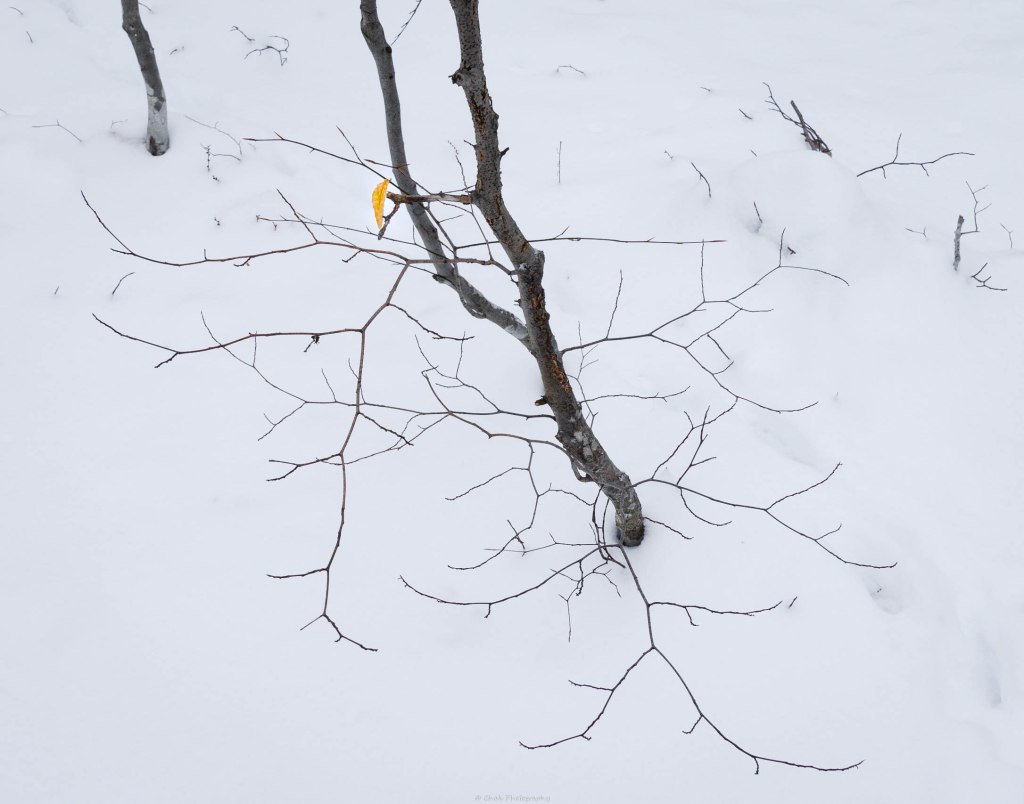
The more you know a place, the more unfamiliar it becomes by revealing its familiarity. And the more you explore, the more familiar it becomes by revealing its unfamiliarity. You see Fourteen Yellow Leaves. One by one, they too will say their goodbyes soon. But now you know each of them, more intimately than before, better than when the whole tree was bedecked with peak foliage. And the farewell will be that much sweeter.
And soon all that will be left, is but a vivid reminder of what it was, and what it could be. And what always is, only if you are not looking for it. In this country, do not set goals, do not settle for something so trivial: you will achieve exactly that goal while missing the many wonders along the way. Let your work be on the sand and stars, let your self dissipate with the wind.
You were lost. You are here. You will not last. But you will not be lost.
(In a fortuitous turn of events, albeit with risks and conscious decision-making, I have been able to live and work in the Adirondack mountains since the summer of 2021. All the above images and words have been a quiet outpour of living and experiencing this place with increasing immersion.
With heartfelt thanks to Guy Tal, whose work and life has been an inspiration to pursue artistic independence and authenticity. You can find more of his work here- https://guytal.com/ .
And deep gratitude to Suvro Sir, whose life and teachings have enlightened me in every step of the way. The quote- “What is death but a long and vivid holiday.” from the poem Swimmers by Louis Untermeyer is just one example of what I remember because this person uttered these words in the most captivating way in English lessons, thousands of miles away and more than a decade ago. You can find some of his writings here- https://suvrobemused.blogspot.com/ .)
“The fault, dear Brutus, is not in our stars, but in ourselves, for we are underlings.”
– Julius Caesar (Shakespeare)
PSYCHOGENETICS – Maurice Wilkins, using nonbiochemical concepts, has defined Psychogenetics to be that branch of evolutionary genetics which deals with the reactions of human genomics to fixed evolutionary and environmental stimuli. Implicit in all these definitions the assumption that the human genome being dealt with is sufficiently large for valid statistical treatment. The necessary size of such a genome may be determined by Franklin’s First Theorem which …..a further necessary assumption is that human conglomerate be itself aware of Psychogenetic analysis in order that its reactions be truly harmless. The basis of all valid Psychogenetics lies in the development of the Foundation alleles which exhibit properties congruent to those of such evolutionary and environmental forces as …
…
Q. Let me suggest that you intend to claim that a period of time preceding the so-called ruin of Earth will be filled with unrest of various types.
A. That is correct.
Q. And that by the mere prediction thereof, you hope to bring it about, and to have then an army of a hundred thousand available.
A. In the first place, that is not so. And if it were, investigation will show you that barely ten thousand are men of military age, and none of these has training in arms.
Q. Are you acting as an agent of another?
A. I am not in the pay of any man, Mr. Advocate?
Q. You are entirely disinterested? You are serving science?
A. I am.
Q. Then let us see how. Can the future be changed, Dr. Franklin?
A. Obviously. This courtroom may explode in the next few hours, or it may not. If it did, the future would undoubtedly be changed in some minor respects.
Q. You quibble, Dr. Franklin. Can the overall genetics of human race be changed?
A. Yes.
Q. Easily?
A. No. With great difficulty.
Q. Why?
A. The psychogenetic trend of a planet-full of people contains a huge inertia. To be changed it must be met with something possessing a similar inertia. Either as many alleles must be concerned, or if the number of alleles be relatively small, enormous time for mutation must be allowed. Do you understand?
Q. I think I do. Earth need not be ruined, if a great many people decide to act so that it will not.
A. That is right.
Q. As many as a hundred thousand people?
A. No, sir. That is far too few.
Q. You are sure?
A. Consider that Earth has a population of over seven billion. Consider further that the trend leading to ruin does not belong to Sapiens alone but to the Ecology as a whole and the Ecology contains nearly a trillion species.
Q. I see. Then perhaps a hundred thousand people can change the trend, if they and their descendants labor for five hundred years.
A. I’m afraid not. Five hundred years is too short a time.
Q. Ah! In that case, Dr. Franklin, we are left with this deduction to be made from your statements. You have gathered one hundred thousand people within the confines of your project. These are insufficient to change the history of Earth within five hundred years. In other words, they can not prevent the destruction of Earth no matter what they do.
A. You are unfortunately correct.
Q. And on the other hand, your hundred thousand are intended for no illegal purpose.
A. Exactly.
Q. (slowly and with satisfaction) In that case, Dr. Franklin- Now attend, madam, most carefully, for we want a considered answer. What is the purpose of your hundred thousand?
…..
A. To minimize the effects of that destruction.
Q. And what exactly do you mean by that?
A. The explanation is simple. The coming destruction of Earth is not an event in itself, isolated in the scheme of human development. It will be the climax to an intricate drama which was begun centuries ago and which is accelerating in pace continuously. I refer, gentlemen, to the developing decline and fall of the Anthropocentric Ecology.
…..
Q. (theatrically) Do you realize, Dr. Franklin, that you are speaking of an Ecology that has stood for years, through all the vicissitudes of the generations, and which has behind it the good wishes and love of more than a hundred billion sapiens?
A. I am aware both of the present status and the past history of the Anthropocentric Ecology. Without disrespect, I must claim a far better knowledge of it than any in the room.
Q. And you predict its ruin?
A. It is a prediction which is made by evolutionary genetics. I pass no moral judgements. Personally, I regret the prospect. Even if the Anthropocentric Ecology were admitted to be a bad thing (an admission I do make), the state of anarchy which would follow its fall would be worse. It is that state of anarchy which my project is pledged to fight. The fall of Ecology, gentlemen, is a massive thing, however, and not easily fought. It is dictated by a rising ocean, receding old-growth forests, a freezing of food sources, a damming of – a hundred other factors. It has been going on, as I have said, for centuries, and it is too majestic and massive a movement to stop.
Q. Is it not obvious to anyone that the Ecology is as strong as it ever was?
A. The appearance of strength is all about you. It would seem to last forever. However, Mr. Advocate, the rotten tree-trunk, until the very moment when the storm-blast breaks it in two, has all the appearance of might it ever had. The storm-blast whistles through the branches of the Anthropocentric Ecology even now. Listen with the ears of psychogenetics, and you will hear the creaking.
Q. (uncertainly) We are not here, Dr. Franklin, to lis-
A. (firmly) Anthropocentrism will vanish and all its good with it. Its accumulated knowledge will decay and the order it has imposed will vanish. Interspecies transgressions will be endless; ecological balance will decay; population will decline; continents will lose touch with the main body of the glaciers. -And so matters will remain.
Q. (a small voice in the middle of a vast silence) Forever?
A. Psychogenetics, which can predict the fall, can make statements concerning the successive dark ages. The Anthropocentric Ecology, gentlemen, as has just been said, has stood twelve thousand years. The dark ages to come will endure not twelve, but thirty thousand years. A Second Ecology will rise, but between it and our civilization will be one thousand generations of suffering. We must fight that.
Q. (recovering somewhat) You contradict yourself. You said earlier that you could not prevent the destruction of sapiens, hence, presumably, the fall; – the so-called fall of the Anthropocentric Ecology.
A. I do not say now that we can prevent the fall. But it is not yet too late to shorten the interregnum which will follow. It is possible, gentlemen, to reduce the duration of anarchy to a single millennium, if my group is allowed to act now. We are at a delicate moment in evolution. The huge, onrushing mass of events must be deflected just a little, – just a little- It cannot be much, but it may be enough to remove twenty-nine thousand years of misery from sapiens genetics.
Q. How do you propose to do this?
A. By saving the knowledge of the race. The sum of human knowing, and human undoing, is beyond any one man; any thousand men. With the destruction of our ecological fabric, environment will be broken into a million pieces. Individuals will know much of exceedingly tiny facets of what is there to know. They will be helpless and useless by themselves. The bits of lore, meaningless, will not be passed on. They will be lost through the generations. But, if we now prepare, a giant summary of all knowledge, it will never be lost. Coming generations will build on it, and will not have to make the same mistakes, and rediscover it for themselves. One millennium will do the work of thirty thousand.
Q. All this-
A. All my project; my thirty thousand with their spouses and children, are devoting themselves to the preparation of a “Genetica Galactica”. They will not complete it in their lifetimes. I will not even live to see it fairly begun. But by the time Earth falls, it will be complete and copies will exist in the genomic library of sapiens. The Foundation Gene, what we have decided to name the dominant allele, will be replicated in all future generations of sapiens. The Second Ecology, I hope, will not be anthropocentric. But it will be humane.
A humble tribute to Isaac Asimov’s “Foundation Trilogy” (from where this conversation was altered to suit the climate change narrative in the current context) and the (mostly) un-recognized work of Rosalind Franklin and Maurice Wilkins on Earth Day, with the dream of a better world.
And I would be amiss if I do not mention my dear Suvro Sir, without whom my affair with Asimov, and other facets of the good life, would be rudimentary at best. Here is his excellent blog that you shouldn’t miss- https://suvrobemused.blogspot.com/
“We must be clear that when it comes to atoms, language can be used only as in poetry. The poet, too, is not merely so concerned with describing facts as with creating images and establishing mental connections.” – Neils Bohr
To create a just society, one only needs to look at the democracy of an atom. How elegantly the electronic citizens exercise their freedom of expression, while faithfully upholding the nuclear constitution. How generously the electrons are shared across the atoms, creating a global molecular community, with every citizen being treated equal before the laws of quantum mechanics. All kinds of molecules, in every possible orientation and conformation, in all kinds of geometry and shapes, fully exercising their right to exist, some stable enough and reclusive, as if a hermit who has made peace with himself, and the world, while some are reactive and radical, as if an activist, trying to touch and transform as many molecules as possible, until every one finds salvation. How prophetically some of them find each other, conjoining forces in genesis, as if seeking a higher purpose in their existence, while fulfilling the same in their lifetime. The genetic ensemble, springing from existing molecules, and sprinting towards virgin ones, sometime dormant over eons, but twisting and turning, permuting and combining, as if waiting for resurrection, bestow life with the right to survive, and thrive, and express, often a failure, seldom fortunate, but none futile. The left leaning amino acids, and the right leaning sugars, working in unison to create that symphony of love, which is neither right, nor wrong, but intelligent to relay the process forward and reach for the stars, and wise to remember the journey it has already made from the stardust. Let us not unravel these delicate strands of life and forego this consciousness. Let us not choose power over knowledge, let us not run away with intelligence, and leave wisdom marooned. Democracy lives within our elements. And the justice we seek, already exists in our genes. Let us find it within ourselves, in each atom of us, in the conscientious pursuit of our consciousness, and in the faith of our shared humanity.
(This is a reflection in times of the impending election in the ‘strongest democracy’, based on an understanding of my background in Chemistry, the good fortune of having the chance to spend time in the wilderness and ponder, and inspired by the many thoughtful quotes, quips, haikus, doodles, and poems from a wonderful class of students at Oxford College of Emory University.)









 Musings from North country